
The Bolligenstrasse Campus on the outskirts of Bern consists of a complex of historic buildings with a spacious park. This valuable complex has evolved over time and impressively documents the development of architecture, open spaces, and the history of psychiatry since the 15th century. Each stage of architectural development is distinctive in its own right and reflects the era in which it was built. The historic buildings, in particular, are a defining feature of the site. Our project proposal aligns with the overarching principle of self-reference.
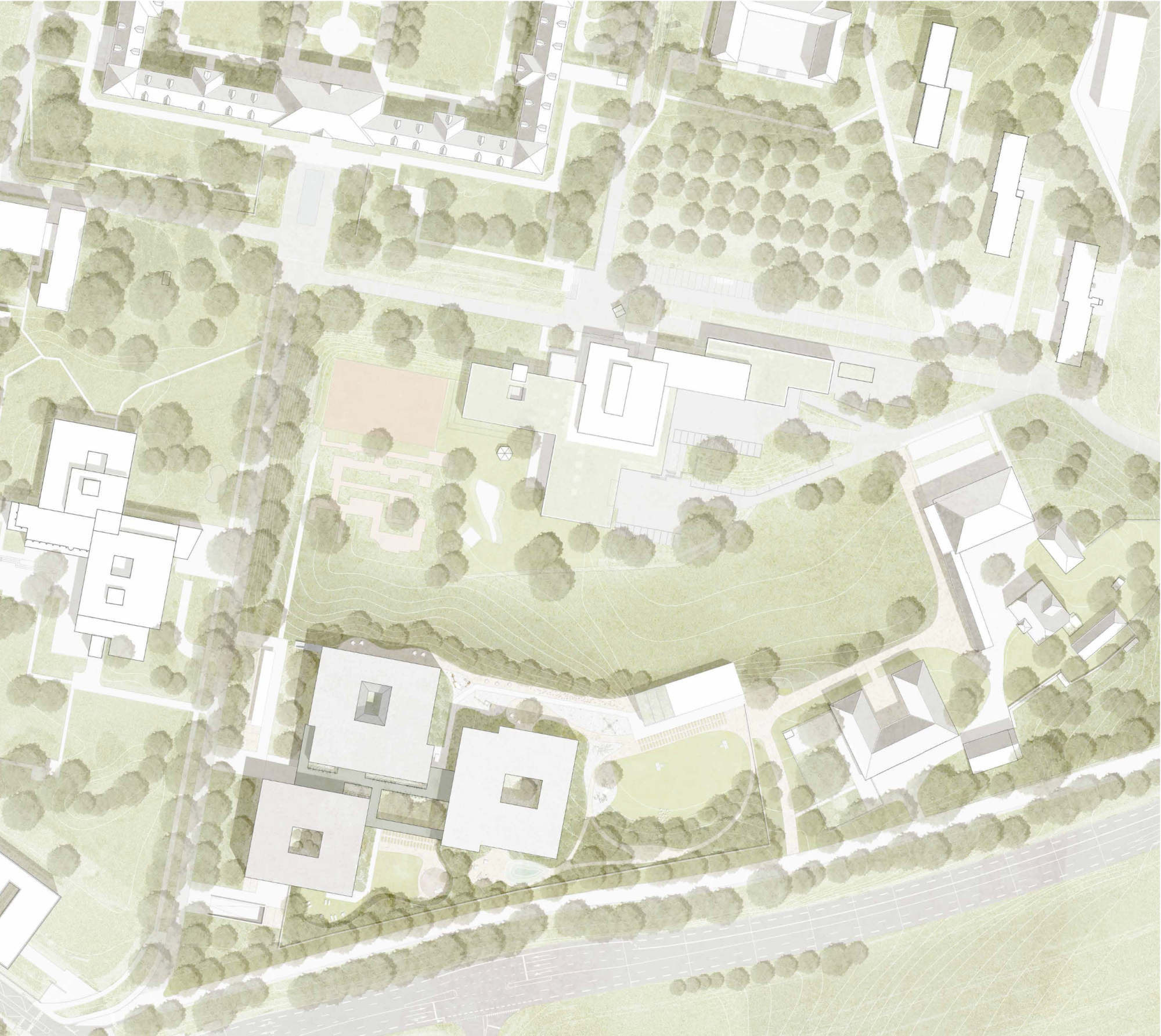
The avenue forms the central element of the overall complex and serves to organize the entire site. In addition, the area is characterized by two distinct categories of spaces: enclosed gardens and flowing open space. This open-space structure creates varying degrees of public accessibility and allows for different forms of engagement, use, and retreat.
The identity and unique spatial character of the site arise from the diversity of places, spatial sequences, and visual connections. In particular, the view from the avenue toward the east still conveys, in places, an original spatial sequence and thus contributes significantly to the historical and atmospheric character of the open space.

The new KJP has a clearly defined entrance from the avenue. Parking spaces for motor vehicles and bicycles are located in a small traffic area, along with the access road to the facility.
The covered passageway marks the entrance to the KJP, which includes the entrances to the day school and the reception area. The covered passageway serves as the connecting element between the three buildings that make up the KJP. Courtyards let in light and bring greenery into the passageway. It becomes a gathering place for the residents of the double-unit facility, offering seating and covered outdoor areas. The passageway leads to the green outdoor areas of the double-unit facilities and the day clinic: the new KJP gardens. These gardens have an entrance at the northwest end that connects the KJP to a surrounding path extending all the way to the new school in the former Tollhaus.
Access to the parking lot is provided as early as possible on the grounds and from the avenue. At the same location, as directly as possible while still being shielded from the public, access to the emergency department and forensic medicine is organized.
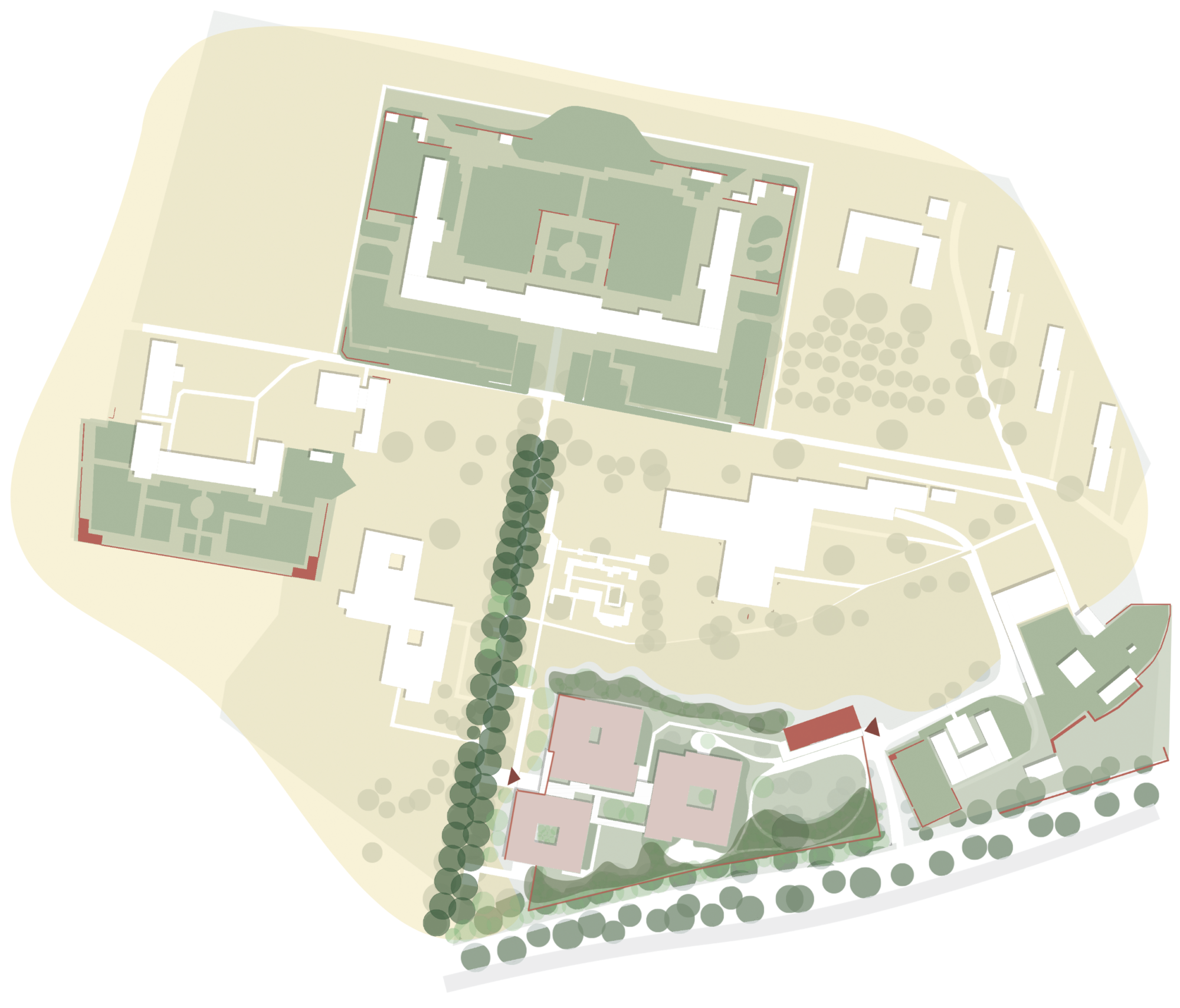
The KJP’s open space is clearly delineated and spatially defined on all four sides. Toward the avenue, the clinic building forms the boundary. At the same time, the flowing landscape extends from the west across the avenue into the KJP’s forecourt, creating the impression that the clinic is directly embedded in the park.
Along the former Bolligenstrasse, the spatial boundary is continued by a garden wall that encloses both the KJP’s garden and that of the Pfundhaus, thereby extending the historic street space. To the east, the open space is also bounded by the garden wall and the woodworking shop building, which defines and shapes the corner in a manner similar to the corner pavilions of the Old Clinic. To the north, the slope of the original moat, with its vegetation serving as a green filter, forms a natural boundary for the site. This creates a clearly defined open space with a spatial structure that is both varied and cohesive.
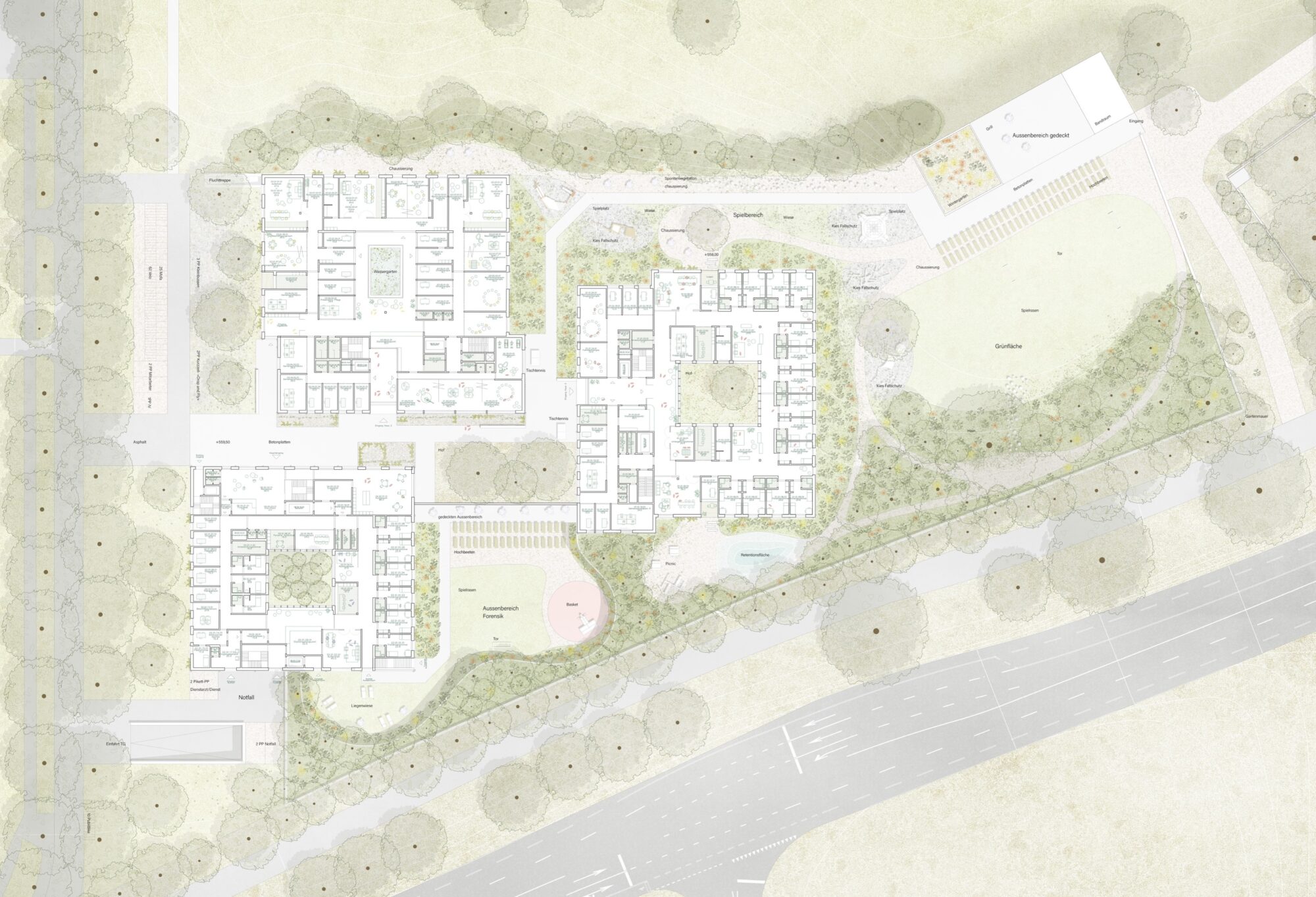
The outdoor area of the forensic unit is located on the south side of the KJP. The desire to create a pleasant outdoor space in the form of a *hortus conclusus* is achieved through a double enclosure facing Bolligenstrasse: a 2-meter-high garden wall and a fence that cannot be climbed. Between the two enclosed areas, a green belt provides visual separation and a sense of seclusion.
The meandering shape of the inner fence divides the outdoor space into different areas while also creating sheltered niches for various uses. Along its path, there are zones for rest and relaxation, a lawn for playing, and a small play area with a basketball hoop. Unlike the other buildings at the KJP, only the Forensic Medicine building has a direct connection to the outdoor space. A central courtyard with large-canopied trees blocks direct sightlines to the other buildings, thereby ensuring a high degree of privacy. The outdoor area of the Forensic Building also includes a covered lounge area next to the raised garden beds, which allows for outdoor dining while offering a view of the garden.